|
Four Modern Monsters
by
J.[esus] Chutney [Frieda Harris]
I - The Exile
"Will I find one?" said Martha.
Martha was an obliger. She lay in bed beside Trixie at 6 a.m. tired and stale.
Trixie was snoring in her day clothes, flat on her back and exhaling an odour of whisky.
Martha got out sideways, dragged on her rumpled stockings, forced herself in her soiled corsets, and hid them under her floral pinafore.
Then she put her feet cautiously into her felt slippers and tied them under the ridge her swollen legs made as they became her swollen feet.
She looked at Trixie. "Drunk again! and she a lady born! the beast!" she said.
Then she brewed some inky tea, putting a heavily sugared cup of it by this friend who had given her room in her bed for months.
Down in the basement she heard the old man cough.
There he lived underground.
She knew his room which had a window that would not open because of the flower-box the old man had put in front of it and which was used by the neighbours cats.
She knew the stains on the walls—the concrete floor—the smoky little range—the tangled gas pipes and dark hanging lamp—the stone passage from the front to the back yard, full of tins and refuse and the unhinged green door which partly hid the common closet.
Once she had rubbed over the linoleum in the smelly scullery. She had not used water—for she would never really scrub—and the dust had fallen into the cracks where she had left it.
Lately the old man had always been in and alone.
"Shall I ever find one?" sighed Martha, and she tottered down the rickety stairs bumping into Albert, who was standing outside the front door as if he was on guard over his rented house.
"Can't you help me find it?" said Martha, but he turned his back and barked "No!" impatiently.
Martha went to work, choosing the shortest crossings to avoid a walk and keeping herself away from the other obligers.
Arriving at the Nursing Home, she went straight to the potatoes and began to scrape them. This she liked—she need only just scrape.
Had she forgotten anything? Her ration book—her oilcloth shopping bag? No! all lay cluttered up behind the door with some pieces of purloined soap.
"If only I could find one!" she murmured. Then she would have flowers; she would dig them in brown fibre, just a bulb or so and perhaps an aspidestra.
Her mind went back to last night, her scurrying to bed early to get a little sleep on the shared mattress before she heard the stumbling of her friend on the stairs—the frequent falls—the wrestling with the door-nob and boisterous entrance fragrant with drink—the vomiting—the flopping into and all over the bed. Well, Trixie was a lady-born and Martha's snob-worship gave her comfort.
Since the war she had been alone; John was dead, and their belongings had been bombed, so now she had to be an obliger.
Here she gave a snort. "Those foreigners they had taken for maids in this house, they wanted to serve. She didn't hold with service, not she"—and she trailed of to find the Hoover.
Drugged by its whirring sound and stupefied by the distant wireless, she wandered to and fro in the middle of the passage dreaming wearily of a day's outing to Southsea last year.
All of them, the obligers, had hired a 'bus and driven tumultuously through the country to the sea—they had bumped along, smoking, each of them in their felt hats and shapeless long cloth coats, grasping their shopping baskets and swaying to the music of the hired accordion which cheered them with its accustomed din and made the journey feel homey. They had eaten their fish dinner and had their shilling sick on the sea. They had all worn paper hats and she remembered that Trixie had a paper coronet. What a day! On clambering back into the 'bus they had been photographed. Yes! she had the photograph—it ought to be framed and hung up somewhere!
"If only she could find one!"
She trundled the Hoover back into the cupboard, flicked at the furniture on the way to the kitchen.
There she looked fearfully round. "They" were not about, so she shovelled the butter which had been left on the plates into a piece of lavatory paper and pushed it into the shopping basket. If they would leave some flowers or a little pot of geraniums that would fit into the corner of the basket and not show, but where could she keep it?
Half-an-hour before time, she waddled out, her legs were stiff after the work, she would go to the doctor, he could be had for nothing and she felt grand sitting in his room, and those glasses too, they might be fetched.
But she was tired; so collecting a meat-pie and a packet of chips from the grocer and pushing an unwrapped loaf of bread under her arm, she made for home.
Seated on the only chair, she ate her meal washed down by black tea, but her restlessness increased.
She must go out and look for it.
She put on her coat and went slowly to the Town Hall and along its familiar passages flanked by many numbered doors.
Among a queue of chattering women she waited till she reached the desk.
"Have you found one yet? she said. The sleek official looked at her—"Your name will come up in six months time", he said, "but I doubt if we can allow your application—"
She went out silently and drifted down the street, peering into every window and back-yard, and even looking at the sky.
Wearily she trailed back, her felt slippers sticking to the dank pavement.
As she reached her front door, she saw Albert.
He pointed to the basement where she could hear the water seeping and could see the collection of dirt and cans.
He said "The old man's dead, you can have that one!"
II - The Sadist
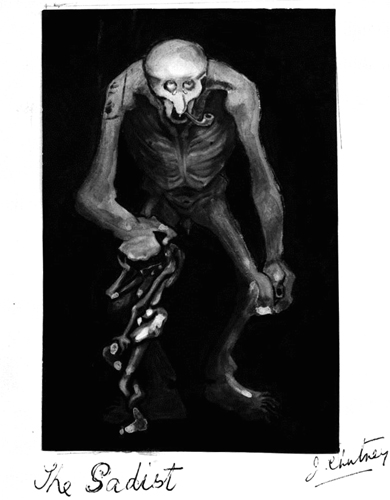
Old Eddie Puss had been got up.
It was 9.30 a.m. and he was slumped in his broken arm-chair.
He ached and the lumps on all his joints were swollen. He dribbled too, for he did not like to wear the teeth Anty got for him.
"I ain't much good I ain't", he droned—"no-one helps me—no-one—am going down hill".
He fumbled in his coat pocket, his fingers sticking to the old rags, tobacco, toffee and teeth jumbled up in it.
"Anty should clean this out" he grumbled. "Can't find the dratted thing—don't want those teeth".
He felt cautiously along the table with his eyes shut for his pipe, smarmed his fingers into the butter left about, crashed into the tea-pot which stood ready brewed beside him with the stale milk, fly-infested sugar and dried up bacon—all of which poor Anty had left before she rushed out to her work.
Eddie wiped his fingers on a grease patch in the front of his old coat and sniffed appreciatively at the familiar smell of fat and kipper.
This gave him the impetus to find his way to Anty's sofa-bed where he fumbled among the coarse blankets and sodden sheets, till guided by stale scent he drew out Anty's rag of a handkerchief and blew his nose. He put it back at once—Anty did not like him to touch her things—her things indeed, he was her father, she owed everything to him, and it was her duty to look after him now he was so old and feeble and going down hill.
He shuffled over to the sink and groped among the things that cluttered there: pieces of meat on cracked plates, cigarette ashes, dirty knives and forks, odd tea-pots full of stale tea-leaves.
He tried to find a cloth and his hands came against slimy mops, greasy flannel and fragments of slithery soap.
The acrid stuffy smell which came from the washing-up bowl told him he was in his own room. If he did not open his eyes, he could see as well as feel and smell the customary disorder of his home.
But he would not look. Long ago he had found out that Anty would work better for him when she was sorry for him, so he always kept his rheumy eyes shut and the habit grew on him. Now he felt and fumbled, even if he were alone. And, as he was blind, Anty became his supporting staff.
He toddled weakly back to his chair and stuffed his grimy pipe.
Then he settled down to doze and think out what he wanted done by Anty. She was better than his old wife who used to shout at him—loud-voiced Joan—she was older than he and bullied him as if she had been his mother. Yes! he was glad that day when, at the top of the stairs she had started scolding him in her raucous voice and he had given her a little push. She seemed to lose her balance and had fallen and broken her neck.
How he had shouted for the neighbours after that unexpected crash and silence—how they had crowded round him to shield him from the horror.
He chuckled—it had been a good wheeze, that tragic loss, and Anty had taken her mother's place.
He fancied, though, she had been getting a bit short with him lately, how dare she say she was tired, she was young and it was her job to support him. He would see to it. Perhaps she would do more if he limped a bit. Yes! his leg did hurt him, he was getting so old—Anty must bathe it and rub it for him.
Now Eddie wondered if it was too late and he felt the face of the clock—nearly 12.15.
Anty should be here with his fish and chips—he could eat it at once on its oily newspaper wrapping. He felt hungry and slobbered.
He got up stealthily, to practise his limp, taking care not to catch his foot on the torn carpet.
Then he heard the sound of voices and hustled back into his chair, groaning audibly. "There she is", he muttered, and called—"My leg hurts!—I'm a poor old lame man. You won't have me long".
A shabby girl came in carrying a paper parcel. She was very thin and plain though she had tried to smudge over her disheartening sluttishness with the usual regalia of lip-stick and powder.
Almost leaning against her was a weedy young man.
"Are you alright Dad?" she said monotonously—and clutched at the simpering youth.
"Ere's Enry. 'E wants to marry 'im!"
Eddie Puss' jaw dropped—"I am going down hill" he wailed, "you can't do that!"—and in his blind disbelief he opened his eyes.
III - The Stowaway
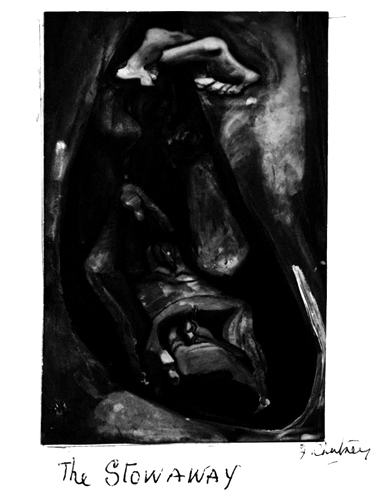
Leonard pushed his arm-chair back and looked disconsolately at the smouldering fire.
"Where is Mary?" he said fretfully, "I want my lunch!"
And then, as there was no response, he wriggled back into his chair and thought of last night.
He had spent a good evening with Maggie, airing his opinions on art and women and Mary had been silent, looking rather beautiful in a deep blue dress and wearing the ruby cross he had given her. She had been painting some Annunciation lilies, and he imagined she was brooding over her picture.
Suddenly she said, "I want a fortnight's holiday!"
It was an idiotic interruption and he had tried to explain it kindly by saying—"Sketching I suppose?"
"No", Mary replied, "a holiday with a man, a stranger!"
Everyone laughed, but Mary had seemed hurt. What did she really mean—he wondered lazily.
Just then the front door shut and Mary came in.
Leonard was small and he looked younger than Mary, whose glance embraced him with tender consideration.
"I want my lunch!" he said.
"Dear" she answered gently, "getting the rations means waiting about". And then she turned to make up the fire, sweeping the coal which was really only dust—"You might get some more coal—ring up, will you?" he said.
Mary divided the food into large and small portions, and Leonard ate unthinkingly, helping himself liberally to the butter. Over the coffee he had pushed his cup forward and emptied the sugar-basing into it. Mary seemed preoccupied and sighed several times.
As soon as he could, Leonard hurried into his study. He turned on the wireless to inspire him in the play he was writing.
But he couldn't write to-day and doodled on the blotting paper, making circles and cups. "Really, this room is not comfortable", he thought, as he frowned at the little vase of flowers Mary had put on his table, and then at the untidy papers and books which had fallen on the floor. He shivered away from the pale distempered walls and those two beige arm-chairs, carefully put opposite one another and annoyingly unreceptive. He had a feeling he was outside, not wanted, and that he must impress his personality on someone. Maggie would not do, she was too hard.
"Where is Mary?" he muttered, "I want to talk to her!"
But Mary was not there; he sank back in his chair, put his pipe in his mouth and sucked at it meditatively.
He remembered his old home, how warm and cozy it had been, the nursery walls were papered with huge crimson roses and the carpet was a blood red. A large fire seemed always burning and he used to squeeze himself into the alcove by the chimney to wait for his Mother to bring him his evening cup of milk.
Chords of affection had bound him to her memory and he had wound himself round her life.
He gave himself a little shake—"Mary" he called, "I want to talk to you about this plot".
She came slowly into the room, an almost mulish expression on her face.
He was determined to catch her attention—"Mary", he said, "What do you think the heroine should do if the man who wants her, cannot find her? Do you remember where I got to in the story?"
"Escape!" said Mary, and again an expression of pain crossed her face. She made a gesture of defence.
"Escape?" he cried, "shat do you mean? that's all wrong! Why should she?"
"It is all wrong!" she answered vaguely, "it's upside-down!"
"Nonsense!" said Leonard, "he needed her, why should she escape?"
"Perhaps he was too much for her. I have always thought he might not have needed her so much if he could have cut himself free", said Mary, meekly.
"But why should he—he needed her as a refuge from suffering," retorted Leonard irritable. "Don't be silly—I mean to do it my way and he must have a happy ending—Mary! do you hear?"
Mary looked tortured. She got up quickly as if to push him away.
"I am tired", she said, "Will you go out with the letters, and don't forget the key. I may not hear you when you return and you know the bell is broken!"
"What is the matter?" shouted Leonard. "How can I go out with the letters. You can't expect me to do this work unless I am comfortable and not disturbed—you should take care of me. My mother was wonderful, she understood. With all the pressure of this chaotic world upon me now I must be comforted!" and his voice rose to a hysterical scream.
Mary hesitated; she looked as if an agony of exhaustion possessed her.
Convulsively she went towards him and covered his hand firmly in her own.
At once he sat down, relieved, saying, "Let me see now!—where did we get to?—oh! I know—Mary let me in!"
IV - The Masquerader
Polly scrambled out of her twin bed.
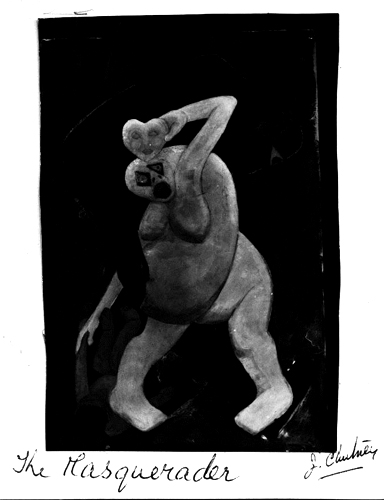
She went straight to the mirror and began to comb out her permanent wave and to make sure yesterday's bleach had hidden all the dark roots of her hair. Finding scratches on her long crimson nails, she revarnished them.
While she was waving her fingers daintily and thinking she had now been married to Gussie for over two years, and that her second baby was on the way, Polly peered anxiously at her image in the glass for signs of strain. But large china blue eyes and a perfect pink and white face stared back at her.
She pencilled a line where her eyebrows had been and pursed her lips to outline them with scarlet lip-stick.
She could hear little Johnnie shouting in the next room, he had been doing that for two hours. "Dear little boy," she twittered.
Then she looked at her husband, his mouth was wide open—his face was greasy with sleep, and his beard was beginning to show.
"Dear Gussie!" she said, "he is almost my dream-husband! wake up dear!"
Gussie grunted. "Eh! is it time to get up?"
Polly turned her shining morning face towards him.
"Yes, darling, I'll soon have your breakfast ready!"
She pinned on her torn celluloid apron which covered her ugly bulge and tripped into the kitchen.
"Hark at Johnnie", she thought, "his dear little voice is quite loud! I must hurry, I must go to him, I must get the breakfast!"
She grasped a tin saucepan and put it on a flickering electric ring, whose cable had worn thin its composition case.
She beat up the powdered egg and gazed at the melting margarine turning to water. It was queer to her—it looked like butter, and the omelet looked like an omelet, but it had a peculiar smell!
"Gussie", she called in silvery tones, "hurry up!"
He came in, rubbing his face with soap.
"It won't lather!" he said. "Darling," she fluted, "you know it wasn't on the ration, it's a preparation".
"And the brush—bristles come out!" he added.
"Yes darling, they aren't real bristles you remember". She almost sang this.
He put his arm round her and leant his head against her. "At least I have got my real golden-haired little wife", he chanted. She gave him a careful kiss afraid of smudging her complexion.
But she cooed about her Gussie, pouring out his chlorided tea. "Empire Brand" she read from the small packet she had opened that morning.
When her man had gone and the daily woman arrived, Polly smiled happily. "Such a kind woman!" she thought, as she watched her hanging up a huge empty bag and pulling out the vacuum cleaner. For an hour the dear creature would clean up and get little Johnnie washed and fed.
Still Polly had a queer feeling of being hurried—there was too much to do.
She went to the telephone. "Hullo! oh! it's you darling—no, it's wonderful of you—yes, I've got those exquisite stockings—Gussie adores them—yes! they do seem to ladder but they look like real American nylons—Did you say you were coming to take care of little Johnnie—he worships you—hullo! hullo!—they've cut me off!"
"Operator!" she dialed feverishly and waited, turning over the "Radio Times" for the day's programme.
"Hullo? Yes, excuse me miss, but through a mistake I have been cut off!"—all this in dulcet tones—"Oh! you say the 'phone is out of order—no doubt it will soon be alright—it worked a minute ago", and she put the receiver down brightly.
Then she caught sight of the daily woman disappearing with a bulging bag and heard bangs and squeals from the Nursery.
"Well!" thought Polly, "she's finished early, but isn't she a help!" She passed her pink celluloid comb through her glittering locks and returned to the kitchen. "I wonder why she has not washed up, and I wonder if she did brush the floor" mused Polly. "Anyhow, Johnnie is up, I can hear his little feet pattering down the passage!"
Trying to light her cigarette with the new lighter Gussie had given her, she found it would not spark and remembered she could only get a substitute refill, but she held it in two fingers with the little one stuck out and that made her know she was a pretty creature. "Such a good think I smoke" she thought as she fluttered to the front door to answer the husky bell.
Her Mother came in: she was cross.
"My dearest" piped Polly, "you are an angel, Johnnie is longing for you!"
Her mother grunted and pushed past her—a scream came from the Nursery and sounds of banging. "I'll turn on the wireless, he loves music", said Polly sweetly.
But the switch stuck and the machine only whirred.
"Oh, Johnnie hit it with a hammer yesterday. Gussie said it was no good, something about the parts not being assembled properly!"
Polly smiled at the lovely technical knowledge Gussie had shown though he could not repair the machine.
"Mother, darling!" she called. "I must go out, I must hurry, I'll see you when I come in! Such a lot to do—"
Polly skipped downstairs and along the street. She paused to look at the new bust supports and elastic belts at the drapers—they were so pink and glistening, made of synthetic satin. Not every size though!
She bought a blackish loaf, Pom, and tinned vegetables.
She was in a hurry to-day and jammed her parcels in her basket, but she did not forget to smile bewitchingly at the butcher.
In the shop-window reflections she saw herself, a dear little woman, fragile and sweet.
Hurrying home she pushed open the hall door—what had happened?
The darling room looked tawdry and her Mother had gone and taken Johnnie with her.
The passage was strewn with toys, boots and clothes. There must have been a struggle.
A sudden bang alarmed her, it was the pressure-cooker which burst open.
She heard the radio moaning dismally, and the Hoover mysteriously connected, was buzzing loudly. The washing-up machine was grinding round and round with the enclosed cups and glasses rattling dangerously.
A loud whistle from a boiling kettle shocked her and, as she stumbled to it, the steam covered her face with moisture. The new blinds Gussie had just tacked up, fell with a slap. Her foot caught in a lamp-wire and the whole carpet heaved.
The wall mirror tipped towards her, and came away from its loose fastenings dragging pout lumps of plaster as it crashed. She tried to push it away—"Help! help!" she gasped, "I am all alone!"
Then, for the first time, in the shattered glass, she saw herself as she really was—a little terrified creature with hollow eyes and shameless form overpowered by her clinging burdens—and she screamed.
|