|
Tales of Manhattan
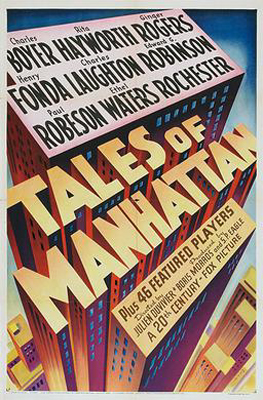
Tales of Manhattan is a 1942 American anthology film directed by Julien Duvivier. Thirteen writers, including Ben Hecht, Alan Campbell, Ferenc Molnár, Samuel Hoffenstein, and Donald Ogden Stewart, worked on the six stories in this film.
Plot: Based on the Mexican writer Francisco Rojas González's novel, Historia de un frac ("Story of a Tailcoat"), the stories follow a black formal tailcoat cursed by a cutter as it goes from owner to owner, in five otherwise unconnected stories.
The first is a love triangle between Charles Boyer, Thomas Mitchell, and Rita Hayworth. Boyer plays an actor who gives his finest performance when he's shot by a jealous husband while wearing the jacket.
The second tale is a comic story featuring Ginger Rogers who finds a romantic love letter in her future husband's jacket. Her fiance (Cesar Romero) enlists his best man (Henry Fonda) to help bail him out. Things don't go as expected when Rogers falls in love with Fonda and dumps her boyfriend.
The third tale stars Charles Laughton as Charles Smith, a poor but brilliant musician, composer and conductor whose one big chance at fame and recognition is in jeopardy. While he attempts to conduct, the small jacket rips and the audience erupts with laughter. In a poignant moment, the orchestra's Maestro (Victor Francen) empathizes with Smith, removes his own tailcoat, and begs him to continue; the "gentlemen" in the audience remove their own tailcoats in a show of solidarity.
The fourth tale stars Edward G. Robinson as an alcoholic former lawyer who takes a last shot at life by borrowing the tailcoat from a rescue mission to attend his 25th college reunion. The lawyer tries to convince his former classmates that he is successful, but one of his classmates (George Sanders) knows that Robinson was disbarred for unethical behavior. When a guest loses his wallet the group hold a mock trial where Robinson ultimately decides to admit that he is a derelict. The next morning his classmates come to his mission where he is offered a good job, and is back on the road to respectability.
The final tale involves a thief (J. Carrol Naish) who steals the coat from a second-hand shop to commit a robbery at a gambling party where everyone is in evening dress. In his escape by plane, the jacket catches fire and the panicked thief throws it out with $43,000 still in the pockets. The day before Christmas, Luke (Paul Robeson) and Esther (Ethel Waters), a poor black couple, find the jacket and money. They take it to their minister (Eddie Anderson) to give to his congregation to buy what they pray for. An old farmer (George Reed) tells Luke that the only thing he prays for is a scarecrow. They take the shredded jacket and make a scarecrow out of it.
Controversy surrounding fifth tale upon 1942 release: The final tale, starring Paul Robeson and Ethel Waters and depicting what were considered racial stereotypes even in 1942, came under severe criticism from both Edward G. Robinson and Robeson, a champion of good film roles for blacks. After a career of only 12 movies and refusing lucrative film offers for over three years, Tales of Manhattan was Robeson's final attempt to work within Hollywood, yet Robeson was deeply disappointed with the sequence, which featured musical numbers by Robeson and the Hall Johnson choir.
He initially thought that he and his associates could use the depiction of the plight of the rural black poor—shown in the film as investing the bulk of their windfall in communal land and tools - to demonstrate a share-and-share-alike way of life. Although he attempted to change some of the film's content during production, in the end he found it "very offensive to my people. It makes the Negro childlike and innocent and is in the old plantation hallelujah shouter tradition . . . the same old story, the negro singing his way to glory". To Robeson, it was a matter of human dignity, and outweighed what he considered his duty to propagandize for communal ownership, inserted into the storyline for Robeson by screenwriter Donald Ogden Stewart, like Robeson a member of the Communist Party, USA.
Some reviewers and black entertainers (including Clarence Muse), noted that the film exposed blacks’ living conditions under the sharecropping system, but Robeson was so dissatisfied that he attempted to buy up all the prints and take the film out of distribution. Following its release, he held a press conference, announcing that he would no longer act in Hollywood films because of the demeaning roles available to black actors. Robeson also said he'd gladly picket the film along with others who had found the film offensive.
Cast: Charles Boyer as Paul Orman Rita Hayworth as Ethel Halloway Ginger Rogers as Diane Henry Fonda as George Charles Laughton as Charles Smith Edward G. Robinson as Avery 'Larry' L. Browne Paul Robeson as Luke Ethel Waters as Esther Eddie Anderson as Rev. Lazarus (billed as "Rochester") Thomas Mitchell as John Halloway Eugene Pallette as Luther Cesar Romero as Harry Wilson Gail Patrick as Ellen Roland Young as Edgar Marion Martin as Squirrel Elsa Lanchester as Elsa Smith Victor Francen as Arturo Bellini George Sanders as Williams James Gleason as 'Father' Joe Harry Davenport as Prof. Lyons J. Carrol Naish as Costello Uncredited cast members include Frank Orth, Christian Rub, Sig Arno, Harry Hayden, Morris Ankrum, Don Douglas, Mae Marsh, and Clarence Muse. |