|
The Great Dictator
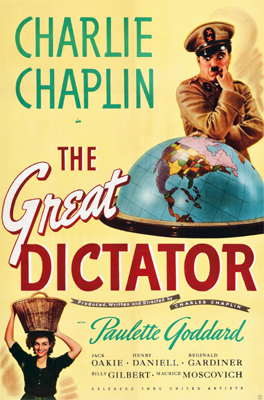
The Great Dictator is a 1940 American political satire comedy-drama film written, directed, produced, scored by and starring Charlie Chaplin, following the tradition of many of his other films. Having been the only Hollywood film-maker to continue to make silent films well into the period of sound films, this was Chaplin's first true sound film.
Chaplin's film advanced a stirring, controversial condemnation of Adolf Hitler, Benito Mussolini, fascism, antisemitism and the Nazis. At the time of its first release, the United States was still formally at peace with Nazi Germany. Chaplin plays both leading roles: a ruthless fascist dictator and a persecuted Jewish barber.
The Great Dictator was popular with audiences, becoming Chaplin's most commercially successful film. Modern critics have also praised it as a historically significant film and an important work of satire. The Great Dictator was nominated for five Academy Awards – Outstanding Production, Best Actor, Best Writing (Original Screenplay), Best Supporting Actor for Jack Oakie, and Best Music (Original Score).
In his 1964 autobiography, Chaplin stated that he would not have made the film if he had known about the true extent of the horrors of the Nazi concentration camps at the time.
Plot: The action starts in 1918, with the defeat of the Tomainian army. A Jewish barber saves the life of a wounded pilot, Schultz (Reginald Gardiner), but loses his own memory through concussion.
Twenty years later, still suffering from amnesia and not having aged a single day, the barber escapes from his care-home to return to the ghetto. The ghetto is now governed by Schultz, who has been promoted in the Tomainian regime under the ruthless dictator Adenoid Hynkel, who looks like an identical twin of the barber (both played by Chaplin).
The barber falls in love with a neighbor, Hannah (Paulette Goddard), and together they try to resist persecution by storm troopers. The storm troopers capture the barber and are about to hang him, but Schultz remembers that the barber had saved his life during the war, and restrains them.
Hynkel tries to finance his military forces by borrowing money from a Jewish banker called Hermann Epstein, but the banker obviously refuses to lend him the money. Furious, Hynkel orders a purge of the Jews. Schultz protests this inhumane policy, and is removed from office and sent to a concentration camp. He escapes and hides in the ghetto with the barber. Schultz tries to persuade the Jewish family to mount an assassination attempt against Hynkel, but they decline to participate in his plan. Storm troopers search the ghetto, arresting Schultz and the barber. They are sent to a concentration camp. Hannah and her family flee to freedom in the neighboring country of Osterlich. Hynkel has a dispute with the dictator of the nation of Bacteria, a man named Napaloni (a spoof of Mussolini played by Jack Oakie), over which country should invade Osterlich. After signing a treaty with Napaloni, Hynkel invades Osterlich. The Jewish family is trapped by the invading force.
Escaping from the camp in stolen uniforms, Schultz and the barber, dressed as Hynkel, arrive at the Osterlich frontier, where a huge victory-parade is waiting to be addressed by Hynkel. The real Hynkel is mistaken for the barber while out duck-shooting in civilian clothes, is knocked out and is taken to a concentration camp. Schultz tells the barber to go up to the platform and impersonate Hynkel, as the only way to save their lives once they reach Osterlich's capital. The barber has never given a public speech in his life, but he has no other choice.
The terrified barber mounts the steps, but is inspired to seize the initiative. Announcing that he (apparently Hynkel) has had a change of heart, he makes an impassioned plea for brotherhood and goodwill.
You, the people, have the power to make this life free and beautiful, to make this life a wonderful adventure.
Then—in the name of democracy—let us use that power—let us all unite. Let us fight for a new world—a decent world that will give men a chance to work—that will give youth a future and old age a security. By the promise of these things, brutes have risen to power. But they lie! They do not fulfill that promise. They never will!
Dictators free themselves but they enslave the people! Now let us fight to fulfill that promise! Let us fight to free the world—to do away with national barriers—to do away with greed, with hate and intolerance. Let us fight for a world of reason, a world where science and progress will lead to all men’s happiness. Soldiers! in the name of democracy, let us all unite!
Finally, he addresses a message of hope to Hannah, in case she can hear him.
Look up, Hannah. The soul of man has been given wings, and at last he is beginning to fly. He is flying into the rainbow—into the light of hope, into the future, the glorious future that belongs to you, to me, and to all of us.
Hannah hears the barber's voice on the radio. She turns her face, radiant with joy and hope, toward the sunlight, and says to her fellows, "Listen."
Reception: Chaplin's film was released nine months after Hollywood's first parody of Hitler, the short subject You Nazty Spy! by the Three Stooges, which premiered in January 1940. Chaplin had been planning his feature-length work for years. Hitler had been previously allegorically pilloried in the German film by Fritz Lang, The Testament of Dr. Mabuse.
The film was well received in the United States at the time of its release, and was popular with the American public. The film was also popular in the United Kingdom, drawing 9 million to the cinemas, despite Chaplin's fears that wartime audiences would dislike a comedy about a dictator. It was the second-most popular movie in the US in 1941.
The film was banned in several Latin American countries, where there were active movements of Nazi sympathizers.
During the film's production, the British government had announced that it would prohibit its exhibition in the United Kingdom, in keeping with its appeasement policy concerning Nazi Germany. But by the time the film was released, the UK was at war with Germany and the film was welcomed in part for its obvious propaganda value. In 1941, London's Prince of Wales Theatre screened its UK premiere. The film had been banned in many parts of Europe, and the theatre's owner, Alfred Esdaile, was apparently fined for showing it.
When the film was released in France in 1945, it became the most popular film of the year, with admissions of 8,280,553.
Chaplin biographer Jeffrey Vance concludes his lengthy examination of the film, in his book Chaplin: Genius of the Cinema, by asserting the film's importance among the great film satires. Vance writes, "Chaplin's The Great Dictator survives as a masterful integration of comedy, politics and satire. It stands as Chaplin's most self-consciously political work and the cinema's first important satire."
Cast: People of the Ghetto: Charlie Chaplin as a Jewish barber in the ghetto, the protagonist. The Barber was a soldier during World War I and loses his memory for about 20 years. After having rescued Schultz during the war, he meets his friend again under radically changed circumstances. Paulette Goddard as Hannah, the Barber's neighbour. She lives in the ghetto next to the barber shop. She supports the Barber against the Tomanian Storm troopers. Maurice Moscovich as Mr. Jaeckel, an elderly Jew who befriends Hannah. Mr. Jaeckel is the renter of the barber salon. Emma Dunn as Mrs. Jaeckel Bernard Gorcey as Mr. Mann Paul Weigel as Mr. Agar Chester Conklin as Barber's customer
People of the Palace: Charlie Chaplin as Adenoid Hynkel, the main antagonist. Hynkel is the Dictator of Tomania (a parody of Germany and Adolf Hitler) and attacks the Jews with his storm troopers. He has Schultz arrested and has his storm troopers hunt down the Barber. Hynkel is later arrested by his own soldiers, who mistake him for the Barber. Jack Oakie as Benzino Napaloni, Dictator of Bacteria, a parody of Italian dictator Benito Mussolini. Reginald Gardiner as Commander Schultz, a Tomanian who fought in World War I, who commands soldiers in the 1930s. He has his troops abstain from attacking Jews, but is arrested by Hynkel, after which he becomes a loyal ally to the Barber. He later leads the invasion of Osterlich and helps the Barber to become Fuhrer. Henry Daniell as Garbitsch, a parody of Joseph Goebbels, and Hynkel's loyal Secretary of the Interior and Minister of Propaganda. Billy Gilbert as Herring, a parody of Hermann Göring, and Hynkel's Minister of War. He supervises demonstrations of newly developed weapons, which tend to fail and annoy Hynkel. Grace Hayle as Madame Napaloni, the wife of Benzino who later dances with Hynkel. Carter De Haven as Bacterian ambassador. |