|
PUNCH London, England 19 September 1956 (page 346)
CRITICISM
BOOKING OFFICE 666
The Magician. W. Somerset Maugham. Heinemann, 15/— One or two persons stared at seeing a woman come out of that hotel in a tea-gown without a hat.
Well they might stare, for the hotel was the Carlton, the period 1907, and the lady in question fleeing from her husband who was a sorcerer. Mr. Maugham prefaces this novel—or rather thriller—which originally appeared nearly half a century ago, with a fragment of autobiography describing some of his early days in Paris. There he had run across Aleister Crowley (1875-1947), that latter-day exponent of the Black Arts; and he used Crowley, under the name of Oliver Haddo, as model for the villain of this tale.
Mr. Maugham also tells us that on its first publication Crowley himself gave the book a full-page review in Vanity Fair. He adds: “I did not read it, and wish now I had. I dare say it was a pretty piece of vituperation, but probably, like his poems, intolerably verbose.”
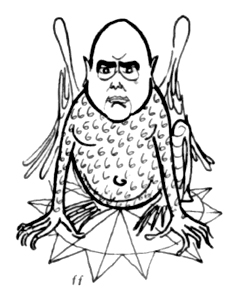
If Crowley gave The Magician a bad review he was behaving even worse than usual; because Mr. Maugham’s story makes his prototype much that Crowley wished to be, and was not; that is to say an enormously rich Old Etonian of ancient lineage, with a beautiful ancestral home in Staffordshire, and the power of creating homunculi. These latter were housed in the attics of his country seat, enclosed in huge test-tubes of glass an inch thick. Sinister? A thousand times yes! But also jolly successful; even though Haddo does eventually get strangled—on the astral plane—by a Harley Street surgeon whose fiancée he had stolen by foul means and married.
The strange thing is that the book does give a vivid impression of what Crowley was like; and he was sufficient of an oddity to make a record of this kind interesting.
The son of a well-to-do brewer, who was
also a Plymouth Brother, Crowley (who named himself
“Aleister”) tacks on to the tail-end of the ‘nineties,
publishing a book of “decadent” poems at Cambridge, and
showing early signs of his lifelong penchant for the occult.
It seems incontrovertible that he was good at chess and
mountain climbing. His other activities are fraught with
discredit and contradiction. He dissipated a comfortable
fortune—considerably less than Haddo’s, one imagines—fairly
early in life.
He once gave me luncheon, years and years ago, at Simpson’s in the Strand, a meal at which he drank milk. His manner was that of a general who had been removed from his command for dropping shells into his own trenches. “Crowley, I think you have got such a kind face,” a well-known beauty of what is now a slightly earlier generation once said to him in the bar of a public house. That was not, strictly speaking, true. There was something ludicrous about him, especially his accent, which people used to describe as cockney, but which probably derived in truth from the manner of speech in the nineteenth century of the Nonconformist sects with which he had been brought up. However, ludicrous or not, if anybody can be described as “sinister” I think Crowley could reasonably be called so. Certainly his path was haunted by suicide and disaster.
What an odd feeling Mr. Maugham’s story gives one! How we have all changed since those days; not least Mr. Maugham’s own literary style. Crowley himself has crossed the river, whither bound it would be impertinent to speculate. The rest of us, hatless and tea-gownless—but no longer stared at like poor Margaret Dauncey—move through a world in which the creation of a homunculi would now probably have to be laboriously effected through the good offices of the Health Service in a mansion given over to the National Trust.
Anthony Powell |